







Lean Six Sigma Yellow Belt (LSSYB) Overview – Self-Paced Online Exam Preparation Training with Exam Voucher (E-Learning)
E-learning code:
Experience live, interactive learning from home with this Online Instructor-led Lean Six Sigma Yellow Belt training program. Engage directly with expert instructors, mirroring the classroom schedule for a comprehensive learning journey. Enjoy the convenience of virtual learning without compromising on the quality of interaction.
The Lean Six Sigma Yellow Belt Professional Development Program is designed to provide participants with a fundamental understanding of Lean Six Sigma principles and methodologies across various industries and sectors. This program can be advantageous for a wide range of professionals, including:
- Supervisors
- Directors
- Process Operators
- Junior Project Managers
- Quality Control Technicians
- Customer Service Representatives
- Manufacturing Professionals
There are no formal prerequisites for this Lean Six Sigma Yellow Belt training program. However, if you have a foundational understanding of Business Performance Development concepts, proceeding with the training program will be beneficial.
Module 1: Introduction to Lean 6 Sigma
- What is Lean 6 Sigma?
- Two Parts of Lean 6 Sigma
- Focus of Lean
- Lean Temple
- Focus of Six Sigma
- Making Customers Happy
- How They Complement Each Other?
- Key Principles of Lean 6 Sigma
- Lean 6 Sigma Belts
- TKA Lean 6 Sigma Belt Structure
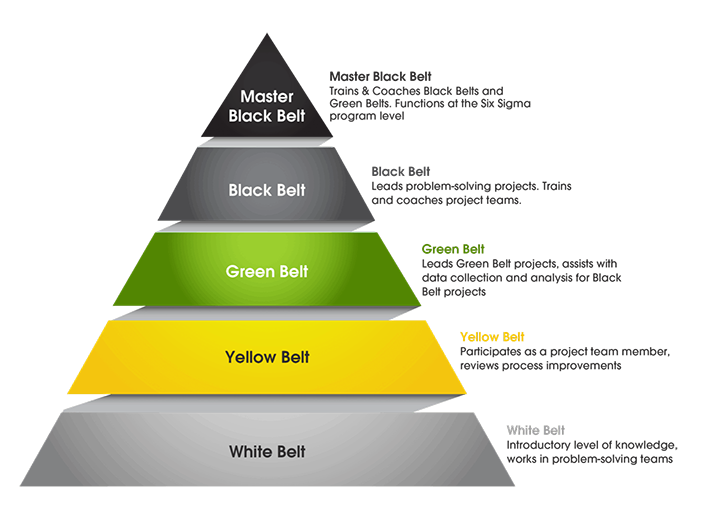
- Training Roadmap and Role of the Yellow Belt
- L6S Support Network
- Processes
- Different Ways of Looking at Process Improvement
- What is a Process?
- Process Concepts
- Types of Process
- Comparing Process Types
- Customers, Value, and Waste
- What are Customers?
- Who Wants the Outputs?
- Tension Between the VOB and VOC
- What Do We Mean by Value?
- Path to Value
- Dealing with Values
- Muda (Waste)
- Wastes (Muda) of Lean
- Types of Demand
- Case Study Exercise
- Key Metrics
Module 2: DMAIC Cycle
- What is DMAIC?
- Define
- Common Tools for Define Phase
- Gemba Tools
- Process Stapling
- Measure
- Common Tools for Measure Phase
- Spaghetti (Movement/Transportation) Diagrams
- Measure Tool: Measles Charts
- Analyse
- Common Tools for Analyse Phase
- Improve
- Common Tools for Improve Phase
- Control
- Common Tools for Control Phase
Module 3: Yellow Belt methodologies and toolsets
- Lean Triad
- 5s
- Poka Yoke
- SMED
- Voice of the Customer (and CTQ’s)
- Customer Chains
- Steps of VOC
- Affinity Diagrams
- Kano Diagrams
- CTQs and Requirements
- SIPOC
- What is a SIPOC?
- CSandF Web Fulfilment SIPOC
- Creating a SIPOC
- Top Tips – SIPOC
- Value Stream Analysis
- Value Stream Terminology
- Process Maps
- Aim of Value Stream Mapping
- Swim Lanes and Typical Process Map Contents
- Value Stream Maps
- Headache Tablets: Value Stream Mapping
- Heijunka
- Heijunka in a Nutshell
- Single Piece Flow
- Pull
- Kanban
- Three-Bin System
- Andon
- Variation and SPC
- Statistical Process Control (SPC)
- Two Types of Process Variation
- Red Bead Experiment
- Standard Deviation (SD) and Understanding Control Charts
- Defects and Process Capability
- Conversion Table
- Process Capability
- Identifying Process Efficiency
- Key DPMO Terms
- Identifying the Root Cause(s)
- 5 Whys
- Fishbone Diagram
- Solving Problems
- Problem Solving Framework
- Prioritization Tools
- methodologies and toolsets to Generate Needed Solutions
- Introduction to Kaizen
- Kaizen in a Nutshell
- Kaizen in a Business Setting
- Lean Teams
- Introduction to Lean Team
- Managing Progress and Demonstrating Control
Lean Six Sigma Yellow Belt Examination Specifications:
To attain the Lean Six Sigma Yellow Belt credential, candidates must successfully complete the certification examination. The examination specifications are as follows:
Question Format: Multiple Choice
Total Questions: 40
Passing Threshold: 70% (28/40 Marks)
Time Allocation: 60 Minutes
Candidates must complete the Lean Six Sigma Yellow Training Programme before sitting for this examination.
Do you have any questions about e-learning?

Course Administrator


One of the most useful trainings I've attended so far. It was great to use practical examples that I apply in my work!
István Rákász