








Lean Six Sigma Black Belt (LSSBB) – Self-Paced Online Exam Preparation Training with Exam Voucher (E-Learning)
E-learning code:
Experience live, interactive learning from home with this Online Instructor-led Lean Six Sigma Black Belt training program. Engage directly with expert instructors, mirroring the classroom schedule for a comprehensive learning journey. Enjoy the convenience of virtual learning without compromising on the quality of interaction.
The Lean Six Sigma Black Belt Professional Development Program in Hungary is for everyone who is focused on Business Performance Improvement. This Lean Six Sigma Certification Course will be particularly advantageous for the following professionals:
- Senior Managers
- Project Managers
- Quality Managers
- Process Improvement Specialists
- Operations Directors
- Continuous Improvement Managers
- Supply Chain Managers
- Manufacturing Engineers

The Lean Six Sigma Black Belt Professional Development Program is for everyone who is focused on Business Performance Improvement. This Lean Six Sigma Certification Course will be particularly advantageous for the following professionals:
- Senior Managers
- Project Managers
- Quality Managers
- Process Improvement Specialists
- Operations Directors
- Continuous Improvement Managers
- Supply Chain Managers
- Manufacturing Engineers
There are no prerequisites for the Lean Six Sigma Black Belt training program. However, you will need to make the below-mentioned minimal arrangements before the commencement of the training program:
You will need a laptop with a copy of Minitab installed for the Black Belt section of the training program.
A 30-day trial version is available, and details of how to install this are included with your pre-training program reading materials.
Pre-install Minitab properly, as the 30 days must cover the duration of the Black Belt training program (please note that Minitab is currently unavailable for Macs).
Module 1: Introduction to Lean 6 Sigma
- What is Lean 6 Sigma?
- Lean 6 Sigma Belts
- Processes
- Customers, Value, and Waste
- Key Metrics
Module 2: Reviewing Process and Qualities
- What is DMAIC?
- Define
- Measure
- Analyse
- Improve
- Control
Module 3: Yellow Belt methodologies and toolsets
- Lean Triad
- Voice of the Customer (and CTQ’s)
- SIPOC
- Value Stream Analysis
- Heijunka
- Variation and SPC
- Defects and Process Capability
- Identifying the Root Cause(s)
- Solving Problems
- Introduction to Kaizen
- Lean Teams
Module 4: Improvement Methodologies
- DMAIC
- 3Cs
- 8Ds
- Plan Do Check Act
- Kaizen
- Design for Six Sigma (DFSS)
Module 5: SPC Basics
- Terminology
- Data Types
- Normal Distribution and Standard Deviation
- Process Capability
Module 6: Lean Management and Cell Theory
- Role of the Lean Manager
- Work Cells
- High Performing Teams (HPTs)
- Rapid Action Teams (RATs)
- Visual Management
- Bruce Tuckman’s Group Development Model
- Emotional Cycle of Change (ECOC)
- Personality Styles
- Dealing with Resistance
Module 7: Risk Management
- Green Belt Risk Management
- FMEA: Failure Mode and Effects Analysis
Module 8: DMAIC for Green Belts
- Define Phase
- Measure Phase
Module 9: SPC methodologies and toolsets
- Frequency Distribution Tables
- Bar Charts and Histograms
- Pareto Charts
- Box and Whisker Plots
- Normal Distribution and Control Charts
- Calculating Process Efficiency
- Scatter Diagrams and Regression
Module 10: Analyse Phase
- Analyse
- Process Maps
- Process Map Levels
- On the Ground Instructions (OTGIs)
- Value Stream Maps
- What is a Value Stream?
- Creating the “As Is” VSM
- Investigating and Understanding the Process
- Headache Tablets: Value Stream Mapping
- Creating a VSM: Process Borders Definition
- Using Swim Lane Diagrams to Identify Logical Process Blocks
- Process Boxes
- VSM Metrics
- Square Wave
- Kaizen Burst
- Creating an Improved Process
- Layout Diagrams and Headache Tablets
Module 11: Improve Phase
- Heijunka
- Solutions Identified, Selected, Planned, and Implemented
- Standardisation and Documentation
- Communications and Training
Module 12: Control Phase
- Embed the change
- Measure the gain
- Close the project
Module 13: Role of the Black Belt
- Black Belts’ Place in the Business
- Black Belt Skill Set
- Green Belts’ View of the World
- Black Belts’ View of the World
- How the Industry Identifies Black Belts?
- Who does the Black Belt Work with?
- Case Study
Module 14: Black Belt DMAIC
- How the Black Belt helps the Green Belt During DMAIC?
- Measure Phase
- DMAIC Programmes
- Governance
Module 15: Enterprise Risk Management
- Risks Lie in Two Areas
- Who Should Handle Risk?
- DMAIC Risk
- A view of Business Risk Management
- Basic Risk Management Procedure
- Business Risk Management in a Nutshell
Module 16: Physical Cell Design and Optimising Flow
- In a Nutshell
- Task & Work Cells
- Flow Improvement Objectives
- Practical Layout Design
Module 17: Black Belt as a Trainer
- Characteristics of Adult Learners
- Three Common Learning Styles
- Preparing the Training
- Top Tips
- Case Study
Module 18: Statistics Basics
- Introduction and SPC Refresh
- Common Terminology
- Flow Improvement Objectives
- Measuring Uncertainty
- Minitab Run-through
Module 19: Process Capability
- Process Capability: Review from Green Belt
Module 20: Hypotheses Tests
- Introduction to Hypotheses Testing
- Working with Hypotheses Tests
- Hypothesis Test Roadmap
- Anderson Darling Normality Test
- To Open the Worksheet
- The Results
- Testing for Means
- t-tests Consider More than Just the Means…
- t-test Exercise
- Z test
- Testing for Medians
- Where Could I Use Median Tests?
- Median Hypothesis Tests
- Testing for Standard Deviation (Variance)
- Equal Variance Hypothesis Tests
- Exercise: Test for Equal Variance
- Interpreting the Results
- Using Bartlett’s Method
- Testing for Proportions and Percentages
- Proportions and Percentages Hypothesis Tests
Module 21: Exercise Using Minitab’s – 2 Proportion Test
- Scenario
- Abbreviated Instructions
- Reviewing the Results
Module 22: Exercise Using Minitab’s - Chi-Square Test
- Scenario
- Abbreviated Instructions
- Interpreting the Results
Module 23: ANOVA
- Required conditions for ANOVA
- The ANOVA “family”
- ANOVA Terminology
- Hypotheses Tests and One-way ANOVAs
- Exercise - One-way ANOVA
- Exercise - Multi-way ANOVAs
Module 24: Data Collection Planning for Hypotheses Tests
- General Points
- Sample Size
- How a Greater Sample Size Reduces Uncertainty?
- Case Study
Module 25: Design of Experiments (DOE)
- Overview of DOE
- Where to Use Design of Experiments?
- DOE Terminology (1)
- Design of Experiments Flow Diagram
- Walkthrough: SB Glass Co
- Step 1: Investigate the Process
- Step 2: Gather Data
- Recording the Data: Building the Worksheet
- Minitab Creates an Initial DOE Worksheet
- Team Completes the Worksheet
- Step 3: Analyse Data
- Teams’ First Analysis of the Data
- Minitab does its Stuff
Module 26: Probability Distributions
- Overview
- Normal Distribution
- Binomial Distribution
- Poisson
- Exponential
- Weibull
Module 27: Advanced Control Charts
- Introduction and Refresher
- Key Control Charts
- Data Collection Planning for Control Charts
Module 28: Measurement System Analysis (MSA)
- General overview
- Key Metrics
- Using Lean Metrics
Module 29: Lessons from Queue Theory
- Overview
- Understanding Gauge R&R
- Minitab Walkthrough
Module 30: Lean Metrics
- Modelling Queues
- Psychology of Queuing
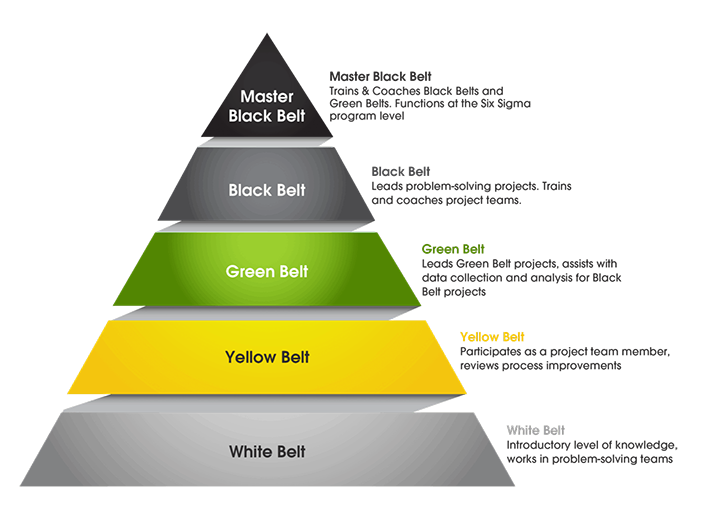
Lean Six Sigma Black Belt Certification
This Lean Six Sigma Black Belt training programme is structured into two modules. The first module covers the Lean Six Sigma Yellow Belt, which outlines the core components of Lean Six Sigma. The first module also encompasses the Lean Six Sigma Green Belt, which builds upon competencies acquired at the Yellow Belt level and introduces the Define, Measure, Analyze, Improve, and Control (DMAIC) methodology. The second module focuses on the Black Belt certification. Candidates must successfully complete the Lean Six Sigma Yellow, Green, and Black Belt Examinations to attain the Lean Six Sigma Black Belt Certification.
Lean Six Sigma Yellow Belt Examination Specifications:
To attain the Lean Six Sigma Yellow Belt credential, candidates must successfully complete the certification examination. The examination specifications are as follows:
- Question Format: Multiple Choice
- Total Questions: 40
- Passing Threshold: 70% (28/40 Marks)
- Time Allocation: 60 Minutes
Candidates must complete the Lean Six Sigma Yellow Training Programme before sitting for this examination.
Lean Six Sigma Green Belt Examination Specifications:
To attain the Lean Six Sigma Green Belt credential, candidates must successfully complete the certification examination. The examination specifications are as follows:
- Question Format: Multiple Choice
- Total Questions: 30
- Total Marks: 85
- Passing Threshold: 70% (60/85 Marks)
- Time Allocation: 120 Minutes
Lean Six Sigma Black Belt Examination Specifications:
To attain the Lean Six Sigma Black Belt credential, candidates must successfully complete the certification examination. The examination specifications are as follows:
- Question Format: Multiple Choice
- Total Questions: 25
- Total Marks: 50
- Passing Threshold: 80% (40/50 Marks)
- Time Allocation: 90 Minutes
Do you have any questions about e-learning?

Course Administrator


The level of organization of the training was surprisingly high, something I have never experienced anywhere else. Our requests were also taken into account.
Gabriella Nagy
ING Biztosító Zrt.